Last updated: July 2026 | By LearnPath Team
The Real Question: Do You Need to Pay to Learn Online?
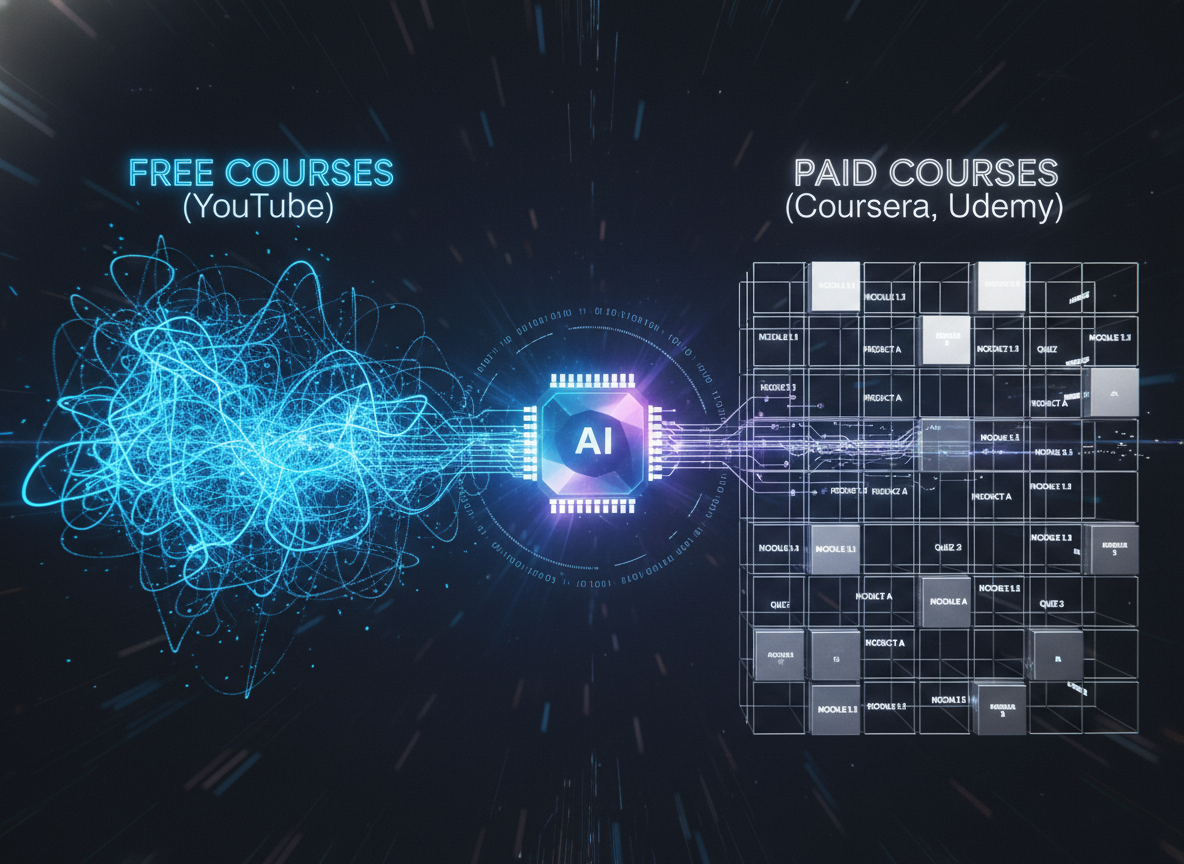
For most topics in 2026, no. The quality of free educational content on YouTube now rivals or exceeds what you get from paid platforms in the majority of subjects. The real gap between free and paid is not content quality - it is structure, accountability, and credentialing. AI-curated platforms like LearnPath are closing that structural gap without charging tuition prices, which is reshaping the entire equation.
That said, the answer depends on what you are learning, why you are learning it, and what you need at the end to prove it. This guide breaks down every major option honestly.
The Current Landscape: Five Ways to Learn Online
The online learning market in 2026 offers a spectrum from completely free to hundreds of dollars per course. Each model makes different tradeoffs between cost, quality, structure, and credentialing.
YouTube: The World's Largest Free University
YouTube hosts over 800 million videos, and a substantial fraction are educational. For virtually any topic - from Python programming to quantum mechanics - dozens of free videos are available right now. Channels like 3Blue1Brown, Fireship, and Khan Academy represent teaching quality that most paid courses cannot match.
The weaknesses are equally significant. There is no curriculum structure. No one tells you what to watch in what order. There are no quizzes, no progress tracking, and no mechanism to identify knowledge gaps. Most people who try to learn from YouTube alone end up watching passively, skipping around randomly, and retaining far less than they think.
Cost: Free. Best for: Supplementary learning, exploring interests, fast-moving technical topics. Biggest weakness: Zero structure, no assessment.
Coursera: University Courses at Subscription Prices
Coursera partners with universities and companies to offer structured courses and professional certificates. A Coursera Plus subscription runs about $59 per month, or $399 per year. Individual courses can be audited for free without certificates.
The structure is genuinely valuable - clear syllabi, weekly modules, quizzes, peer-reviewed assignments, and discussion forums. Professional certificates from Google and Meta carry real weight in hiring. The downsides are cost accumulation and pacing rigidity. At $59 per month, a six-month certificate costs over $350. If you already understand half the material, you still sit through it.
Cost: about $59/month or $399/year (Coursera Plus). Best for: Career changers who need recognized credentials. Biggest weakness: Expensive over time, rigid pacing.
Udemy: The Marketplace Model
Udemy operates as an open marketplace where anyone can publish a course. Quality varies wildly. Prices range from $12 during frequent sales to $200 at list price, though almost no one pays list price. Once purchased, you get lifetime access.
Udemy courses typically include video lectures, exercises, and Q&A sections. Structure within a single course is usually good, but Udemy provides no guidance on which courses to take in sequence to build toward a larger goal.
Cost: $12-$200 per course (typically $12-$20 on sale). Best for: Specific, well-defined skills with a top-rated instructor. Biggest weakness: Inconsistent quality, no cross-course learning path.
Skillshare: Creative Skills on Subscription
Skillshare focuses on creative skills - design, illustration, photography, writing, animation. At $14 per month, it offers unlimited access. Courses are shorter and more project-based, which suits creative fields where learning by doing is effective. The limitation is scope: strong in creative and business skills, thin in technical and academic subjects.
Cost: $14/month. Best for: Creative professionals, project-based learning. Biggest weakness: Limited subject coverage outside creative fields.
LearnPath: AI-Structured YouTube Learning
LearnPath uses AI to transform free YouTube content into structured, adaptive learning journeys. The AI curates videos, generates quizzes from transcripts, and dynamically branches your learning path based on quiz performance. Spaced repetition scheduling ensures long-term retention.
You get the content quality of YouTube combined with the structure of a paid platform. The branching tree advances you to harder material when you demonstrate mastery and routes you to supplementary content when you need reinforcement.
Cost: Free to start (one path, first step unlocked); Pro is $12.99/month, or $8.99/month billed annually. See pricing for details. Best for: Self-directed learners who want structure without course prices. Biggest weakness: Dependent on YouTube content availability; issues completion certificates but not accredited credentials.
When Free Learning Wins
Free content is not just "good enough" in certain situations - it is genuinely superior. Knowing when saves you money and often produces better outcomes.
In fast-moving technical fields like web development, cloud computing, and AI/ML, the landscape changes so rapidly that paid courses are often outdated before students finish them. YouTube creators publish new content covering framework updates and emerging best practices within days of release. In 2026, with AI tools evolving monthly, learning from content even six months old can mean learning the wrong thing.
Free content also wins for broad exploration before commitment. Before investing $300 in a Coursera certificate, you should know whether you enjoy the field. YouTube lets you explore without financial risk.
Finally, some subjects have YouTube content so exceptional that paying for alternatives is irrational. Mathematics, computer science fundamentals (MIT OpenCourseWare, CS50), web development, and personal finance all have world-class free coverage.
When Paid Courses Win
There are legitimate situations where paying provides value that free content cannot replicate.
Formal certification: If your goal is a credential hiring managers recognize, free videos will not get you there. Google, AWS, and Meta certificates carry weight because employers trust the assessment rigor. You are paying for the credential as much as the content.
Highly specialized professional training: Niche skills - advanced statistical methods, enterprise software, regulatory compliance - often lack comprehensive free coverage. The audience is too small for YouTube creators but willing to pay a premium on dedicated platforms.
Structured accountability: Some learners genuinely need external structure. Deadlines, cohort-based schedules, and financial commitment create accountability that self-directed learning lacks. If you have tried free learning multiple times and consistently failed to follow through, the structure of a paid course may justify the price.
The AI-Curated Middle Ground
The traditional choice between free-but-unstructured and paid-but-rigid is a false binary. AI curation creates a third option combining the best of both.
LearnPath solves the primary weaknesses of self-directed YouTube learning - lack of curation, structure, assessment, and adaptive progression - without traditional course costs. The AI evaluates videos for quality and accuracy, sequences content logically, generates quizzes from actual transcripts, and adapts the path based on your performance.
The comparison is no longer "free versus paid" but "unstructured versus structured." AI makes structure available without a premium price tag. You can explore how LearnPath stacks up against specific platforms on our comparison page.
How to Decide: A Practical Framework
Choose free YouTube if you are exploring a new interest, learning a fast-moving technical skill, or supplementing knowledge from other sources.
Choose Coursera if you need a recognized professional certificate for a career transition or want university-level academic rigor.
Choose Udemy if you need a specific, well-defined skill and can identify a top-rated instructor through reviews.
Choose Skillshare if your focus is creative skills and you prefer short, project-based courses.
Choose LearnPath if you want structured, adaptive learning without premium pricing and do not need formal credentials. Check our pricing page for free tier details.
Frequently Asked Questions
Can you actually get a job with free online learning and no certificate?
Yes, particularly in tech fields like software development and data analysis. Employers increasingly value demonstrated skills over credentials. A strong portfolio or GitHub profile often matters more than a certificate. That said, certificates help get past automated resume screening at large companies, so the value depends on where you are applying.
Is Coursera worth the money compared to free YouTube courses?
It depends on whether you need the credential. If you are completing a Google or Meta professional certificate for your resume, Coursera provides unique value. If you are learning for personal growth, the content quality on YouTube is comparable, and AI-structured tools like LearnPath provide the organization and assessment that Coursera charges for.
Why do so many people fail to complete online courses regardless of price?
Completion rates are below 10 percent for most MOOCs and not dramatically better for paid courses. The primary reasons are unrealistic time expectations, lack of adaptive pacing, isolation, and passive consumption without active recall. Adaptive learning systems address these issues by maintaining appropriate difficulty and requiring active engagement through quizzes and spaced repetition.
How does AI-curated learning compare to a human-designed curriculum?
A well-designed human curriculum remains the gold standard for depth and pedagogical nuance. AI curation provides a structured experience dramatically better than no structure at all - which is what most self-directed learners currently have. The advantage of AI is scale and personalization: it creates a customized path for any topic, for any learner, instantly, adapting in real time based on performance.
What matters most when evaluating an online learning platform?
Five factors: content quality (who created it and is it current), structure (logical progression or content dump), assessment (do quizzes verify real understanding), adaptivity (does it adjust to your performance), and cost transparency (what you actually pay over the full journey, not just the advertised rate). No single platform excels at all five, so choose based on which factors matter most for your situation.
The Bottom Line
The best strategy in 2026 is not loyalty to a single platform. Use free content for exploration and fast-moving fields. Use paid platforms when you need credentials or specialized training. Use AI-curated tools like LearnPath when you want structure applied to the vast library of free content already available.
The gap between free and paid is no longer about content quality. It is about structure, assessment, and credentialing. AI is making structure and assessment available without premium pricing. Credentialing remains the one area where paid platforms have an unambiguous advantage - and even that is eroding as employers shift toward skills-based hiring.
Spend your money where it provides unique value. Save it everywhere else. And regardless of platform, prioritize active learning over passive consumption. That single habit matters more than any platform choice you make.