Last updated: July 2026 | By LearnPath Team
What Is Spaced Repetition?
Spaced repetition is a learning technique that schedules reviews of material at progressively longer intervals, timed to occur just before you would naturally forget. Rather than reviewing everything at once, you revisit each concept on an optimized schedule that strengthens memory with minimal effort. It is one of the most research-backed methods for moving knowledge from short-term to long-term memory.
The idea is deceptively simple but extraordinarily powerful. When you first learn something, the memory is fragile. If you do not revisit it, the memory fades within hours or days. But if you review the material at the right moment - just as it is beginning to decay - you reinforce it and push the next point of forgetting further into the future. Each successive review extends the retention interval. What started as a one-day gap becomes three days, then a week, then a month, then three months.
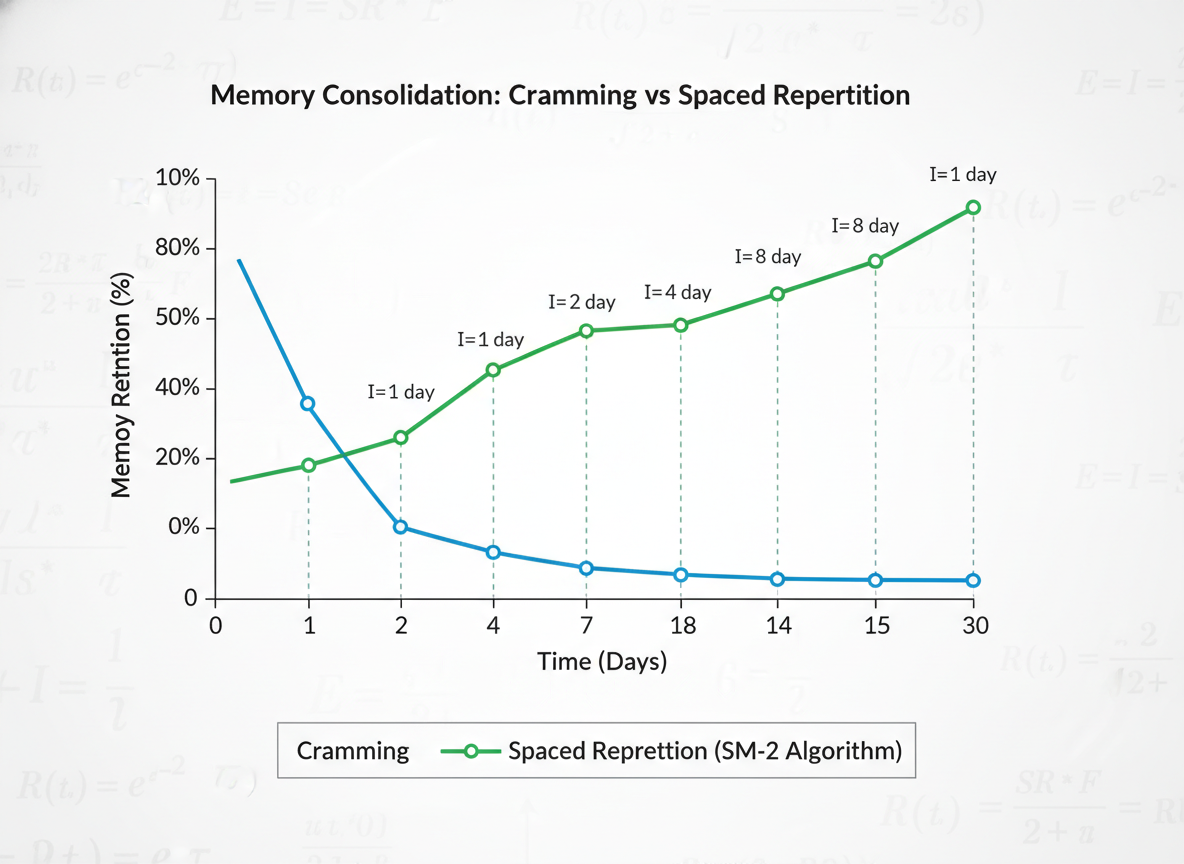
This is not intuition or folk wisdom. Spaced repetition is grounded in over a century of experimental research on human memory. Students who use it retain two to three times more information over the long term compared to those who rely on massed practice - what most people call cramming.
The Forgetting Curve: Why Your Brain Discards What You Learn
The scientific foundation of spaced repetition begins with Hermann Ebbinghaus, a German psychologist who conducted the first rigorous experiments on memory in 1885. By memorizing lists of nonsense syllables and testing his own recall at various intervals, Ebbinghaus revealed a consistent and alarming pattern he called the forgetting curve.
The forgetting curve shows that memory decay is exponential, not linear. Within 20 minutes of learning something new, you lose roughly 40 percent. After one hour, about 55 percent is gone. By the end of the first day, you retain only around 33 percent. After a week without review, as little as 20 percent may remain.
This is not a failure of intelligence. It is how every human brain works. Your brain constantly filters information, discarding what it categorizes as unimportant and consolidating what it encounters repeatedly. The forgetting curve is an efficiency mechanism - your brain assumes that if you never encounter something again, it probably was not worth storing permanently.
The critical insight from Ebbinghaus is that each review resets the curve and flattens it. The first review might sustain the memory for two days. The second extends it to five days. The third to two weeks. With each well-timed review, the intervals between necessary reviews grow longer and the rate of forgetting slows.
Spaced repetition systems exploit this principle by calculating the optimal moment for each review - late enough that recall requires genuine effort (which strengthens the memory), but early enough that the memory has not completely disappeared.
How the SM-2 Algorithm Works
The most widely used algorithm for scheduling spaced repetition is SM-2, developed by Piotr Wozniak in Poland in 1987. SM-2 stands for "SuperMemo 2," and despite being nearly four decades old, it remains the foundation of virtually every modern spaced repetition system, including Anki, Mnemosyne, and LearnPath.
SM-2 tracks three variables for every piece of information you are trying to learn.
Easiness Factor
The easiness factor (EF) represents how easy or difficult a particular item is for you. It starts at 2.5 for every new card and adjusts based on your performance. Items you consistently recall drift toward a higher EF, meaning their review intervals grow faster. Items you struggle with drift toward a lower EF (minimum 1.3), keeping intervals shorter.
The EF update formula is:
EF' = EF + (0.1 - (5 - q) * (0.08 + (5 - q) * 0.02))
Here, q is a quality rating from 0 to 5 representing recall quality. The formula increases EF for high-quality responses and decreases it for poor ones, with the penalty scaling quadratically - a truly poor response affects the EF more than a mediocre one.
Interval Progression
The interval is the number of days until the next review. SM-2 uses a specific progression:
- First successful review: interval = 1 day
- Second successful review: interval = 3 days
- Subsequent successful reviews: interval = previous interval multiplied by the easiness factor
If your EF is 2.5 and your current interval is 3 days, the next interval after a correct answer would be 8 days (3 times 2.5, rounded). Then 20 days. Then 50 days. Intervals grow rapidly for well-known items, freeing review time for material that needs more attention.
If you answer incorrectly, the algorithm resets the repetition count to zero and sets the interval back to 1 day. You start over for that item, but the adjusted EF ensures the algorithm schedules it more conservatively going forward.
Repetition Number
The repetition number tracks consecutive successful recalls. It determines which phase of the interval schedule you are in. A reset to zero on failure gives SM-2 its self-correcting behavior - one mistake triggers a full review cycle, catching items before they slip through the cracks.
The elegance of SM-2 is that it requires no complex machine learning or large datasets. It is a simple, deterministic formula running on three numbers per card, yet it produces scheduling behavior that closely approximates the theoretically optimal review timing predicted by more complex memory models.
Spaced Repetition vs. Cramming: What the Research Shows
The comparison between spaced repetition and cramming is one of the most decisive results in cognitive science. A landmark meta-analysis by Cepeda, Pashler, Vul, Wixted, and Rohrer (2006) examined 254 studies involving over 14,000 participants. The conclusion was unambiguous: distributing study over time produced substantially better long-term retention than concentrating the same study time into a single session, across every material type and age group tested.
The numbers are consistent across studies:
- After one week: Spaced practice produces 30 to 50 percent better recall. Roediger and Karpicke (2006) at Washington University found spaced retrieval practice produced 50 percent better recall at the one-week mark.
- After one month: The advantage grows with time. Bahrick et al. (1993) conducted a nine-year study on foreign language vocabulary and found spaced intervals maintained retention three to five times longer than massed practice with equal total study time.
- After one year: The Cepeda meta-analysis found that properly spaced reviews could maintain retention indefinitely, with optimal gaps increasing as the desired retention interval increased.
Cramming fails not because it does not work short-term - it does. The night before an exam, cramming produces acceptable performance. The problem is that massed practice creates what psychologists call the "illusion of competence." You read material repeatedly, it feels familiar, and you mistake that familiarity for understanding. The information sits in short-term memory but never consolidates into long-term storage. Within days, most of it is gone.
Spaced repetition avoids this trap by introducing deliberate difficulty. Reviewing something after a delay feels harder. That difficulty is not failure - it is the mechanism that drives consolidation.
How LearnPath Implements Spaced Repetition
LearnPath integrates spaced repetition directly into the learning pipeline rather than treating it as a separate activity. The system uses the SM-2 algorithm described above, adapted for video-based learning.
Automatic Card Seeding from Exercises
When you complete a quiz after watching a video, LearnPath analyzes your results and creates review cards from the questions you answered incorrectly. You do not need to manually create flashcards - the system identifies your knowledge gaps and seeds the review queue automatically.
Each card stores the original question, answer options, correct answer, an explanation, and the skill being tested. It also stores the SM-2 variables: easiness factor (starting at 2.5), interval (1 day), and repetition number (0). Questions you answered correctly are not added, keeping the queue focused on genuine weak spots.
Daily Review Queue
Each time you open LearnPath, the system checks for due review cards. A dashboard badge shows the count, and a banner prompts you to complete your session. The review page presents cards one at a time, ordered by urgency - the most overdue cards appear first.
Review sessions cover cards from across all your learning paths. This cross-path interleaving is intentional - research shows that mixing material from different subjects improves retention compared to blocking reviews by topic.
XP Rewards for Consistency
LearnPath awards 10 XP after reviewing at least five cards in a session. This integrates with streaks, levels, and progress tracking, making review feel like a natural part of your routine. The five-card threshold prevents gaming while keeping sessions short enough to sustain daily engagement.
Mastery Tracking
After five consecutive correct reviews, a card is considered mastered. Your review statistics page shows total cards, cards due, mastered cards, accuracy percentage, and total reviews completed - a clear picture of long-term retention progress across all topics.
Frequently Asked Questions
How much time per day does spaced repetition require?
Most learners spend five to fifteen minutes per day. The algorithm concentrates effort on the material that needs it most, and as cards mature and intervals lengthen, the daily workload decreases. Research confirms that this small, consistent investment produces far better results than occasional hour-long study sessions.
What happens if I miss a day of reviews?
Missing a day is not a problem. SM-2 schedules reviews per card, not on a fixed daily cadence. Overdue cards wait for your return, ordered by priority. The algorithm accounts for the delay - a card reviewed late is slightly harder to recall, which actually provides stronger memory reinforcement. The only consequence of missing several days is a larger catch-up queue.
How is this different from using Anki?
Anki is an excellent standalone flashcard tool, but it requires you to create your own cards and manage your own decks. LearnPath generates cards automatically from the content you study, prompts and tracks review sessions within the platform, and feeds review data back into the adaptive learning algorithm that shapes your path. You get SM-2 without the overhead of manual card creation.
Can spaced repetition help with skills, not just memorization?
Spaced repetition is most directly applicable to declarative knowledge - facts, concepts, and principles. For procedural skills like coding, it works best as a complement to practice. LearnPath uses it to reinforce the conceptual foundations that support skill development. Strengthening your understanding of why a technique works accelerates your ability to apply it.
Is the 200% improvement claim realistic?
Yes. The 200% figure (retaining two to three times more) comes directly from peer-reviewed research. Roediger and Karpicke's 2006 study measured 50% better recall after one week with spaced retrieval practice alone. Longer-term studies by Bahrick et al. found three to five times better retention over months and years. The exact improvement depends on material type and review consistency, but the directional finding is robust across hundreds of studies.
Start Retaining What You Learn
Spaced repetition is the single most effective technique for long-term knowledge retention. It turns the forgetting curve from an enemy into an ally by timing reviews for maximum memory reinforcement. LearnPath builds it into every learning path automatically - you watch videos, take quizzes, and the system handles the rest. Explore how spaced repetition, adaptive branching, and AI-powered curation work together at the features page.