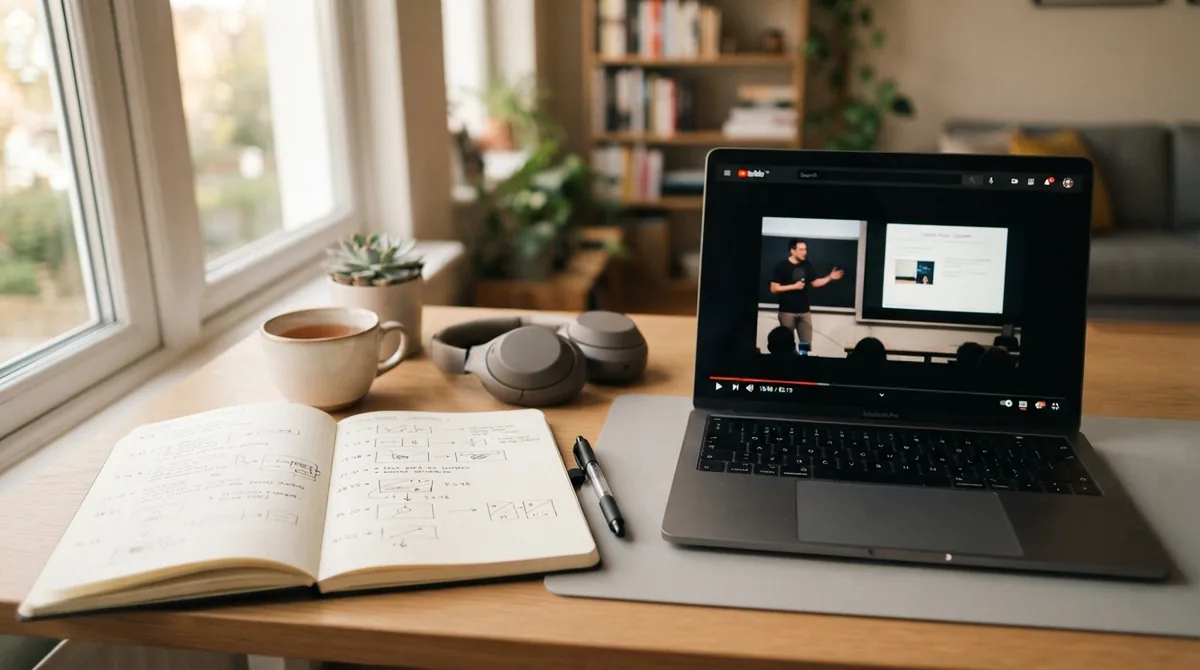
Quick Answer: attach a timestamp to every note
The fix is not a better note-taking app, it is one habit: write the timestamp next to every note you take, not just the idea. Open YouTube's transcript panel, use your browser's find function to locate the line, and click it to jump straight back. A note without a timestamp costs you a full rewatch later; a note with one costs one click.
Why scrubbing back through a video wastes so much time
A 45-minute lecture has no index. If you remember "the part about database indexing" but not the minute mark, your only native option is dragging the scrub bar and guessing, watching snippets at 2x speed until something sounds familiar. That is not a minor annoyance. It is minutes lost per lookup, repeated every time you need to check the same explanation, which for a dense technical video can be several times over a study session.
The root problem is that a video and a note-taking app do not talk to each other by default. Your notes live in one place, the source material lives in another, and the only link between them is your memory of roughly where in the timeline the useful part was. That link degrades fast. What actually closes the gap is a timestamp: a number that turns "somewhere in this video" into "exactly here."
This matters more for how-to and lecture-style content than for entertainment, because you come back to study videos on purpose. A cooking video you watch once. A Docker networking explainer you may need to re-check three times over a project. The rewatch cost compounds specifically for the content people are trying to learn from, which is why this is worth fixing rather than living with.
The other cost is subtler than lost minutes: it is lost momentum. Every time you stop building or stop studying to go hunt for a five-second explanation, you break your own concentration. Getting back into focus after an interruption takes longer than the interruption itself. A note-taking habit that eliminates the hunt does not just save the minutes spent scrubbing, it protects the block of focused time around it.
The note-taking method that actually works
The well-known Cornell note-taking method, taught by Cornell University's own study skills program, splits a page into a note section, a cue column, and a summary, specifically to force you to process material actively rather than transcribe it passively. Cornell's page also states plainly that "research shows that taking notes by hand is more effective than typing on a laptop." The same active-processing principle applies to video: the fix is not fancier software, it is a habit that pairs every note with a retrieval cue. For video, that cue is a timestamp.
The method has three parts. First, open the transcript so you have a text version of the video next to the player; YouTube's transcript panel timestamps every line automatically. Second, when something is worth remembering, do not just jot the idea down, note the minute mark shown in the transcript beside it. Third, phrase the note in your own words rather than copying the transcript text verbatim; summarizing forces the same active processing that makes Cornell notes effective for reading, and it is what separates a useful note from a wall of pasted captions you will never reread.
This works whether you use a plain text file, Notion, Obsidian, or a phone notes app. The tool is not the variable that matters. The timestamp is.
Your realistic options, compared
Several tools exist to speed up the transcript-and-timestamp workflow. Here is how they actually compare, priced as of this run.
| Option | Cost | What it does | Cross-video search | Best for |
|---|---|---|---|---|
| YouTube's native transcript panel | Free | Per-video transcript with clickable timestamps; use your browser's Ctrl+F/Cmd+F to search it | No, one video at a time | Anyone checking back on a single video they already have open |
| Glasp browser extension | Free tier; Pro $12.50/mo | AI YouTube summaries, highlight syncing to Notion, private highlights on Pro | No native cross-video search | Heavy readers/watchers who want summaries and highlights synced automatically |
| Video Highlight | Free tier (3 videos/day cap); Plus $8/mo, Pro $15/mo (billed yearly) | AI transcripts, summaries, and a chat interface per video | Limited, within your saved video library on paid tiers | Researchers processing many long videos who want an AI summary, not just a transcript |
| LearnPath | Free tier; Pro $12.99/mo | Builds a structured path from YouTube videos on a topic, then quizzes you on each video's transcript before you advance | Not a search tool; organizes by topic instead of relying on search | Learners who want to retain the material well enough that they rarely need to search for it again |
The honest read: for a single video you already have open, YouTube's own transcript panel and your browser's find function cost nothing and do the job in under a minute. Paid tools like Glasp and Video Highlight earn their price when you are working through many videos a week and want the summarizing automated, not when you need to find one thing in one video. LearnPath is a different category entirely, it does not compete on search, it targets the underlying reason you need to search in the first place: material that did not stick the first time. Quiz gates after each video force recall before you can move to the next one, which is a different fix than a faster search box.
If you want the research behind why forced recall beats passive rewatching, our post on spaced repetition and how it improves retention covers the mechanism in more depth.
How to take notes on YouTube videos: step by step
-
Open the transcript before you start taking notes. Click the three-dot menu below the video (or the "..." under the description on mobile) and select "Show transcript." The panel opens beside the video with a timestamp on every line, turning the video into a searchable document instead of a stream you can only scrub through. Rev's guide to searching YouTube transcripts walks through the same two clicks if you want a visual reference.
-
Set your note file up with a timestamp column. Whether you use a plain text file, Notion, or Obsidian, put the timestamp first on every line, then your note. A line that just says "explains why indexes speed up joins" is nearly useless three weeks later. A line that says "14:32 - explains why indexes speed up joins" gets you back to the source in one click.
-
Use your browser's find function on the transcript, not the scrub bar. Once the transcript panel is open, press Ctrl+F (Windows) or Cmd+F (Mac) and type the word or phrase you remember. YouTube highlights every match in the transcript text. Click the line, and the video jumps to that exact second. This is dramatically faster than dragging the scrub bar and guessing.
-
Paraphrase, do not transcribe. Copying transcript text word for word feels productive but skips the step that actually builds memory: restating the idea in your own words. Read the transcript line, close your eyes for a second, and write what it meant, not what it said.
-
Review your timestamped notes within 24 hours, using the timestamps to re-check anything fuzzy. This is the payoff of the whole method: instead of rewatching the full video to refresh one point, you jump straight to the 90 seconds that matter and move on.
-
For a whole topic, not one video, stop relying on search and use structure instead. Search-by-transcript works for the specific video you remember watching. It does nothing for the video you have not watched yet that would have answered your question faster. A structured path across a topic, such as LearnPath's AI-curated learning paths from YouTube, solves that second problem by organizing the material up front instead of leaving you to search for it after the fact.
When timestamped notes are not enough
Timestamped notes fix the "I know I saw this, where was it" problem. They do not fix a different problem: not remembering the material at all because you only watched it once, passively. If you find yourself needing to jump back to the same explanation over and over even with good timestamps, that is a signal the material has not actually moved into long-term memory, and more note-taking alone will not close that gap. Our piece on why understanding a tutorial while watching does not mean you can rebuild it later covers the cognitive reason for that, and what to do about it: active retrieval, not better bookmarks.
Frequently Asked Questions
How do I take notes on a YouTube video so I can find a specific part again later?
Write the timestamp next to every note, not just the idea. Open the video's transcript panel, copy the minute mark shown next to the line you care about, and paste it beside your note. A note without a timestamp forces you to scrub the whole video again; a note with one takes you straight back to the source in one click.
Does YouTube have a built-in way to search inside a video's transcript?
Yes. Open the description, click the three-dot menu, and select Show transcript. The transcript panel opens beside the video with a timestamp on every line. Use your browser's own find function, Ctrl+F on Windows or Cmd+F on Mac, to search the visible transcript text, then click any line to jump the video to that exact moment.
Are paid tools like Glasp or Video Highlight worth it over YouTube's own free transcript panel?
Only if you regularly need AI-written summaries or want highlights synced automatically to Notion. For a single video, YouTube's free transcript plus your browser's find function does the same core job: locate a line, jump to its timestamp. Paid tools earn their price when you are processing many videos a week and want the summarizing done for you.
What is the fastest way to review a long lecture without rewatching the whole thing?
Open the transcript, skim it like a page of text instead of watching in real time, and click straight to the two or three sections that matter. Reading a transcript takes a fraction of the time video playback does, and clicking a transcript line jumps the player to that exact second, so you only watch what you actually need to re-hear.
Should I take notes by hand or type them while watching?
Cornell University's own study skills program states plainly that taking notes by hand is more effective than typing on a laptop for retention, likely because you cannot write as fast as someone talks, which forces summarizing over transcribing. If you type, resist copying transcript text verbatim; rephrase each point, and still attach the timestamp.
Can I search across multiple YouTube videos at once, not just one?
Not with YouTube's native transcript panel, which only searches the single video you have open. To search across a whole playlist or channel you need a third-party tool such as a transcript browser extension, or a structured path like LearnPath that organizes videos by topic so you are not relying on search to relocate material at all.